1. Choose fewer goals
Three goals at a time is plenty. Each one gets real attention; ten goals get none. If you're unsure which to pick, rate the main areas of your life, like health, money, work and relationships, and start with the one or two that score lowest. Small improvements there usually change the most.
2. Make it measurable, with a date
“Save more” is a wish. “Save $3,000 for an emergency fund by April” is a goal: you can tell whether you're on track and when to adjust. If the goal has a number, write it down with the date. If it doesn't, define what “done” looks like in one sentence.
Louryx turns a goal with a number into a pace: how much per month or week you need to finish on time, and whether you're ahead of it or behind.
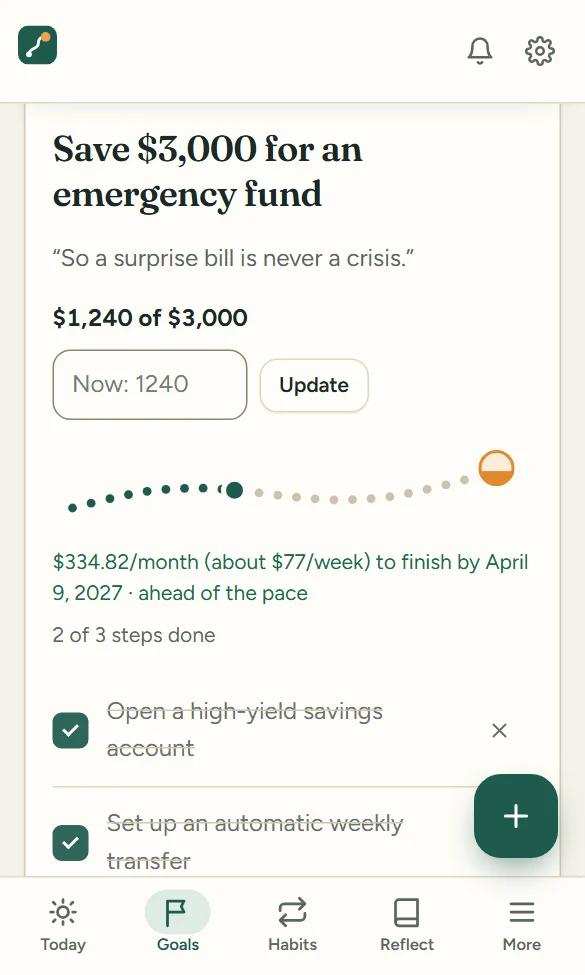
3. Write down why
One sentence is enough: “So a surprise bill is never a crisis.” On the days the goal feels distant, the reason is what brings you back. Keep it next to the goal, not in a separate document.
Good reasons are personal and concrete. “To be healthier” is vague; “to keep up with my kids on weekend hikes” gives you a picture to hold onto. If you can't think of a reason that moves you, that's useful information too: it may not be the right goal for this year.
4. Break it into steps and habits
A goal is reached through two kinds of action: one-time steps and repeated habits. Saving for an emergency fund might be “open a high-yield savings account” and “set up an automatic transfer” (steps), plus “check spending, two minutes, once a week” (a habit).
- List the three to five steps that get you from here to done.
- Make the very first step small enough to do today.
- Add one or two habits at a pace you can keep on a busy week.
- Link each habit to the goal, so every check-in counts toward it.
5. Look at it every week
A yearly goal works when it's looked at weekly. Five minutes on Sunday is enough: what moved, what didn't, and the one thing to focus on next week. If you're behind the pace, adjust the plan instead of abandoning the goal: a later date or a smaller number is still progress.
Louryx's weekly review asks those questions, and every goal shows its progress as a dot moving along a path toward the sun. When you arrive, the sun rises.
Common mistakes with goals
Most goals don't fail because they were the wrong goals. They fail for a handful of predictable reasons:
- Setting too many at once, so none of them gets real attention.
- Leaving out the number or the date, so you can't tell whether you're on track.
- Writing only the outcome, with no step you can take this week.
- Never looking at the goal again after the first excited week.
- Quitting when you fall behind, instead of moving the date or making the target a little smaller.
6. Let someone see it
Telling one person you trust makes a real difference. With Witness in Louryx you can share a single goal through a private link: they see that goal's steps and how many days you showed up this week, and they can send you a cheer. They never see anything else, and you can stop sharing at any time.
The free plan includes one active goal, with Witness. Lifetime removes the limit.