1. Start smaller than feels impressive
Pick a version of the habit you could do on your worst day: a five-minute walk, one page, one glass of water before coffee. It feels too easy, and that's the point. The goal of the first weeks is to become someone who shows up, not to get fit by Friday.
Once the habit is automatic, it's easy to grow it. Going from five minutes to twenty is simple; restarting a habit you abandoned in week two is not.
How long does it take to build a habit?
You'll often hear “21 days”, but the research says it varies a lot. In a well-known study from University College London (Lally and colleagues, 2009), people took anywhere from 18 to 254 days for a new daily behavior to feel automatic, with a median of about 66 days. Simpler habits formed faster; harder ones took longer.
The same study found that missing a single day didn't meaningfully set people back. That's worth remembering: consistency over weeks matters far more than a perfect streak, so plan for about two months and don't panic over one missed day.
2. Tie it to something you already do
“I'll exercise more” has no trigger. “After I pour my morning coffee, I'll stretch for five minutes” does. Attach the new habit to a moment that already happens every day, and add a reminder at that time until the link forms on its own.
3. Choose a pace you can keep on a busy week
Not every habit should be daily. Running three times a week is a better plan than running every day and quitting in March. Decide the pace up front, so a rest day is part of the plan rather than a broken promise.
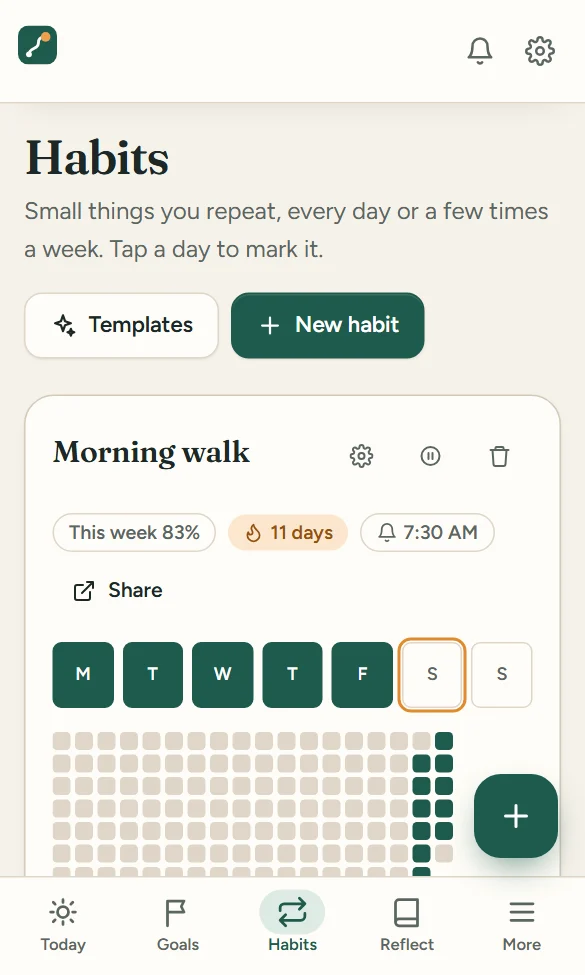
In Louryx a habit can be every day or a few times a week, and it can have an amount, like 8 glasses or 20 pages, so a partial day still counts toward the target.
4. Plan for the days that go wrong
Write down a backup version in advance: “If it rains, I walk indoors for ten minutes.” “If I get home late, I read one page.” Deciding this on a calm day is much easier than improvising on a bad one.
Louryx keeps that if-then plan with the habit and shows it when you need it.
5. Track without all-or-nothing
A streak is motivating until the day it breaks, and then it can make quitting feel reasonable. A good habit tracker keeps the motivation and removes the trap.
- Mark rest days in advance; they keep the streak going without counting as done.
- Keep a streak freeze for a genuinely bad day.
- After a real break, count the comeback (“Back on track: 3 days”) instead of a bare restart.
- Pause a habit during travel or illness instead of deleting it.
6. Connect habits to what you want
A habit is easier to keep when you can see what it's for. Link “move $20 to savings each payday” to the goal it serves and every check-in moves that goal forward. Louryx shows the habit's check-ins on the goal's path, so the small daily action and the big result are visible together.
The free plan keeps up to three active habits forever, which is plenty to start; Lifetime removes the limit. Start with one.